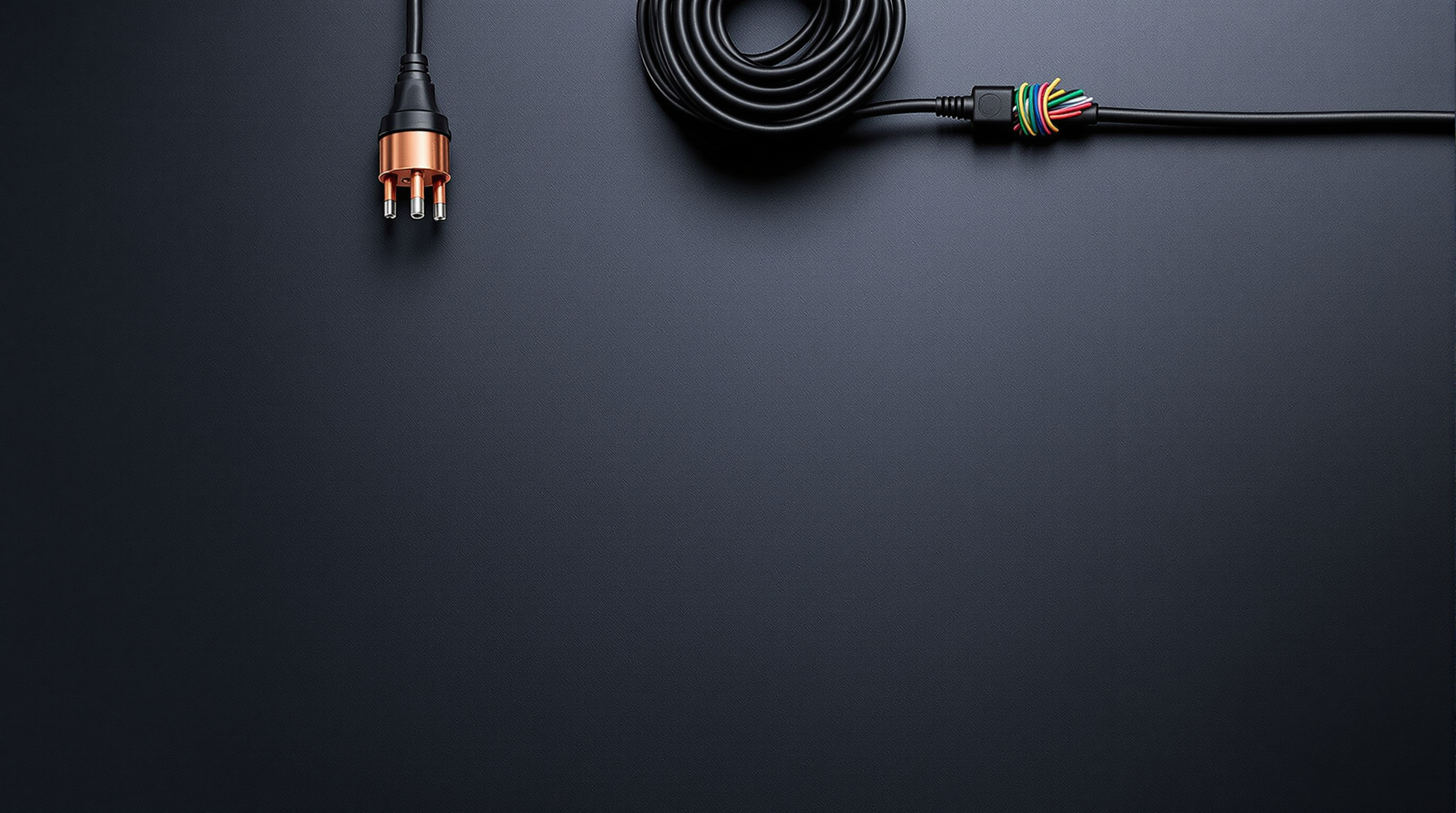
The pages here are organized around the connector families and cord components most people actually search for: the ubiquitous North American plug patterns, the internationally standardized appliance couplers, and the supporting hardware — strain reliefs, harnesses and adapters — that turns a spool of wire into a finished, safe assembly.
For a closer look at both assembly steps and practical bench setup, the wire harness guide follows conductors from layout through termination and testing.
Connector Standards at a Glance
In North America, wiring-device patterns are defined by the National Electrical Manufacturers Association (NEMA). A NEMA designation such as 5-15P encodes the configuration, the current/voltage rating and whether the part is a plug (P) or receptacle (R). Appliance-end connectors follow a separate international system, IEC 60320 (historically written “IEC 320”), which standardizes the detachable inlets and connectors found on computers, monitors and countless other devices.
- NEMA 5-15P & 5-15R — the standard grounded three-prong plug and receptacle
- NEMA 1-15P & 1-15R — the two-blade ungrounded plug and receptacle
- IEC 60320 couplers — C13/C14, C7/C8, C5/C6 and C19/C20 appliance connectors
From Wire to Finished Cordset
Behind every connector sits the cord itself. The insulation compound, conductor count and wire gauge (AWG) determine how much current a cord can safely carry and how it behaves when flexed. Our guide to flexible cord types and wire gauge decodes the UL letter codes (SPT, SVT, SJT, SO) that appear on every jacket.
Where the cord meets the connector, a strain relief protects the conductors from flex fatigue and pull-out — a small part that is responsible for a large share of real-world cord failures. On more complex products, individual cords give way to full wire harnesses and cable assemblies, while specialized applications such as trailer wiring use their own connector conventions entirely.
Safety and Certification
Cordsets sold in North America are typically listed by a recognized testing laboratory. Safety marks from organizations such as UL Solutions and CSA Group indicate that a plug or cord has been evaluated against construction, temperature and pull-test requirements. Installation practices, in turn, follow the National Electrical Code (NFPA 70). Understanding these references is the first step to specifying a cord that is both fit for purpose and compliant.
Use the navigation to explore each connector family and component in detail. Every page is written as a neutral technical explainer — no sales pitch, just the standards and the reasoning behind them.